Google
 
Showing posts with label Street Food Trip. Show all posts

Monday, December 17, 2007

Taho

This street food (beverage) will totally start off your day, or even relax you in the middle of the afternoon by just one sip. Everywhere you go, you will see Taho vendors walking around carrying those large aluminum containers containing this sweet and perfect Taho. Usually in the morning you could hear loud "Tahooooo" screams from the Taho vendor telling people to buy one.

Taho is a Philippine snack food made of fresh soft/silken tofu, arnibal (brown sugar syrup), and sago "pearls" (similar to tapioca pearls). This staple comfort food is a signature sweet and can be found all over the country. The Indonesian equivalent of this dish is Tahu.

The Magtataho or taho vendors are a common sight in the Philippines. They are typically male and carry two large aluminum buckets that hang from each end of a long wooden plank or yoke.

Most magtataho carry plastic cups for their product, often in two sizes (though vendors in residential communities tend to use their customers' cups and price their product accordingly). Using a wide, shallow metal "sandok" or scoop, they skim the surface of the bean curd and toss out any excess water, subsequently scooping the bean curd itself into a cup. Then, using a long thin metal ladle, they scoop sago "pearls" and arnibal into the cup, loosely mixing it in.

Taho is enjoyed either with a spoon or by simply "drinking" it from the cup. Though traditionally served warm, cold varieties exist in supermarkets and in food stalls in cafeterias which have the bean curd in a solid, unbroken state. These pre-packed cups tend to contain a firmer tofu which need to be broken up and is sold either with a plastic spoon or a wooden popsicle stick.

This street food is best enjoyed hot, and you could even request for additional arnibal from the vendor and he wouldnt mind!


Balut

The ultimate street food, the Balut. This must be the master of all street food! It's hard to convince non-filipino people to atleast try this unique filipino delicacy. Why wont you trust us when we say that it is so damn delicious! Not to be biased, but really, all filipinos recommend Balut if you want to know about street food.

Balut is a fertilized duck (or chicken) egg with a nearly-developed embryo inside that is boiled alive and eaten in the shell. Balut are most often eaten with a pinch of salt, though some balut-eaters prefer chili and vinegar to complement their egg. The eggs are savored for their balance of textures and flavors; the broth surrounding the embryo is sipped from the egg before the shell is peeled and the yolk and young chick inside can be eaten. All of the contents of the egg are consumed. In the Philippines, balut have recently entered higher cuisine by being served as appetizers in restaurants: cooked adobo style, fried in omelettes or even used as filling in baked pastries.

Fertilized duck eggs are kept warm in the sun and stored in baskets to retain warmth. After nine days, the eggs are held to a light to reveal the embryo inside. Approximately eight days later the balut are ready to be cooked, sold, and eaten. Vendors sell cooked balut out of buckets of sand, used to retain warmth, and are accompanied by small packets of salt.

Balut has been the "shocking" topic of some television shows because of its taboo nature in some Western cultures. In two episodes of Survivor: Palau and two episodes of Survivor: China, the contestants were made to eat this Asian delicacy. Similarly, balut is frequently featured on Fear Factor. Recently, contestants of The Amazing Race Asia 2 had to eat 8 baluts as a team before receiving their next clue. Balut was also featured on the show Bizarre Foods with Andrew Zimmern, where the host pronounced 18-day-old balut to be one the strangest foods he'd ever eaten in his life, but far better tasting than he had expected. The members of the rock band Switchfoot ate balut on stage at their concert in the Philippines. Video footage of this occurrence can be seen on the Switchfoot Podcast, episode 28.

To all filipinos who haven't yet tried eating Balut, It's a pity!

Betamax

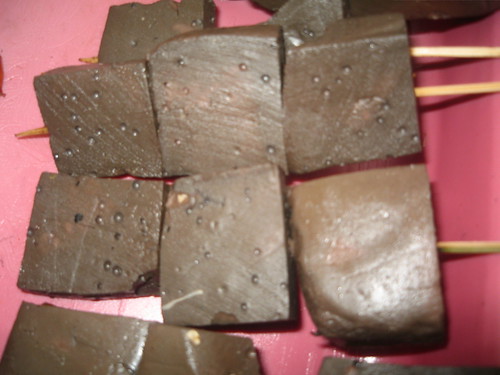
Oh man, we really have weird street food names. Now why betamax? I dont have any idea! If you're wondering what Betamax is, these are actually blood clots, yes, they are solidified blood of a cow/pig. No don't be disgusted, as ugly as they sound to be, they taste great. Also with the barbecued street food family, Betamax is brushed with barbecue marinade and then grilled over live coals. The dipping is the usual spicy/non-spicy vinegar (with chopped onion bits actually) and once you try it, it will totally change your perspective about Betamax.


Adidas

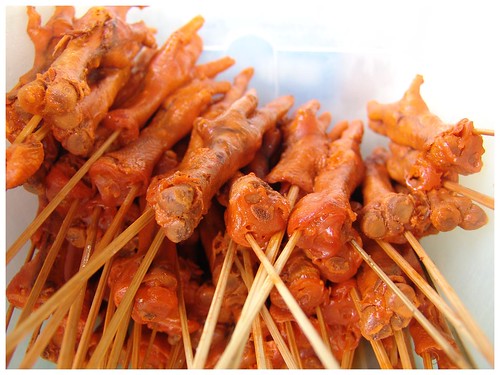
Yes, we call this street food, Adidas. You might relate it with the popular brand of shoes because it's the chicken's feet, but no one really knew how it was named that way. Pull the skin off of these feet by your mouth and experience this little wonders. Usually brushed with barbecue marinade and then grilled above live coals, this would make a perfect entry in our street food trip. Usually dipped in spicy/non-spicy vinegar, Adidas would totally knock your socks off.


Isaw (Pig)

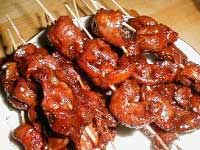
Like Isaw (Chicken), these are also intestines, but from Pigs. Don't judge them on there looks because you might regret it! Pork Isaw is also brushed with barbecue marinade and then grilled above live coals. Dipping it on either spicy/non-spicy vinegar would bring out its excellent taste. This usually costs at around P5.00, more expensive than Chicken Isaw. Be sure to also not eat too much of this for it might cause highblood!

Isaw (Chicken)

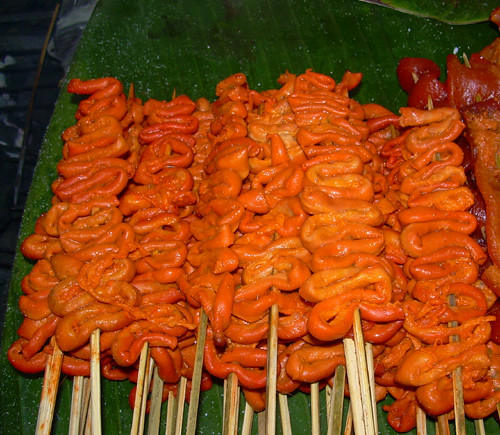
Known as Isaw, these glimmering red chicken intestines are from a different family of street-food. You wont see this with fish balls, but with Pork-Barbecue, Pig's intestines, Pig's Ears, Chicken's Feet, and etc. Ill show you these in a while. Isaw is a favorite filipino street food made with chicken intestines, brushed with a barbecue marinade and then grilled above live coals infront of you. These costs at around P2.00 per stick. Isaw is best if dipped into eaith spicy/non-spicy vinegar. But be sure to not eat too much for its not healthy! Hell, its usually the prohibited things that are so delicious.

Squid Balls


Always around fishballs, this filipino street-food is called the Squid Ball. No one really knows if it is really made from Squid, cause it might be fish too. These are deep-fried and usually dipped into vinegar or that signature brown sauce. This is an all-time favorite because it tastes totally good, and sells at around P2.00 each piece. Like the Fish Balls, the Squid Balls are also a classic, came almost at the same time as the Fish Balls. Once you sink your teeth into this soft white balls, ill guarantee you'll be addicted.


Fish Balls

Those white beauties are called the Fish balls. This street food is a classic! and it may be the first one to exist in the deep-fried street-food world in the Philippines. They are not really shaped like a ball, they're shape are more likely to be like that of a flat-shaped ball. It is made from fish meat that has been finely pulverized. It is somewhat flat in shape and most often made from the meat of cuttlefish or pollock. It is usually served with a sweet and spicy sauce or with a thick black sweet and sour sauce. It is a common snack food that is sold by mobile fryer stands and street corner food courts in many towns and cities.

Fish balls in the Philippines are sold by street vendors pushing mobile deep frying carts. They are usually served with a choice of three kinds of dipping sauces: Sour (pale orange colored) - vinegar, water, diced onions and garlic, Sweet (brown gravy colored) - corn starch, banana catsup, sugar and salt, and Hot/Sour (amber or deeper orange colored) - the sour variety with lots of small hot chilis added.


Kikiam


The streets are not complete without the humble Kikiam! Originally spelled as Que-Kiam, It is another popular Chinese dish adopted into Filipino cuisine. Locally known as kikiam, it is made with ground pork and vegetables wrapped in bean curd sheets then deep-fried until golden. That might sound kinda complicated but once you bite into this street treasure you wont care about anything! Usually deep-fried, served with this signature brown sauce, depends on the recipe of the vendor. Kikiam is always sold where Fish balls and Squid balls are usually sold.


Sunday, December 16, 2007

Kwek-Kwek

Popularly known in the streets of the Philippines as Kwek-Kwek. A hard-boiled quail egg which is deep-fried in an orange batter. It is crunchy on the outside and soft on the inside, and must always be eaten hot, dipped in spicy/non-spicy vinegar, or some of that signature brown sauce that we also use as fishball sauce. It is also available in large regular-sized eggs. Usually costs at around P2.00-P2.50 Pesos. You cannot go wrong with Kwek-kwek! Just be sure to eat just enough because too much eggs are not good for you!